| Version 3 (modified by , 3 years ago) ( diff ) |
|---|
Overview of CIVL-C
Main Concepts
CIVL-C is an extension of a subset of Standard C. It includes the most commonly-used elements of C, including most of the syntax, types, expressions, and statements. Missing are some of the more esoteric type qualifiers, bitwise operations (at least for now), and much of the standard library. Moreover, none of the C language elements dealing with concurrency are included, as CIVL-C has its own concurrency primitives.
The keywords in CIVL-C not already in C begin with the symbol $. This makes them readily identifiable and also prevents any naming conflicts with identifiers in C programs. This means that most legal C programs will also be legal CIVL-C programs.
One of the most important features of CIVL-C not found in standard C is the ability to define functions in any scope. (Standard C allows function definitions only in the file scope.) This feature is also found in GNU C, the GNU extension of C.
Another central CIVL-C feature is the ability to spawn functions, i.e., run the function in a new process (thread).
Scopes and processes are the two central themes of CIVL-C. Each has a static and a dynamic aspect. The static scopes correspond to the lexical scopes in the program—typically, regions de- limited by curly braces {. . . }. At runtime, these scopes are instantiated when control in a process reaches the beginning of the scope. Processes are created dynamically by spawning functions; hence the functions are the static representation of processes.
Example Illustrating Scopes and Processes
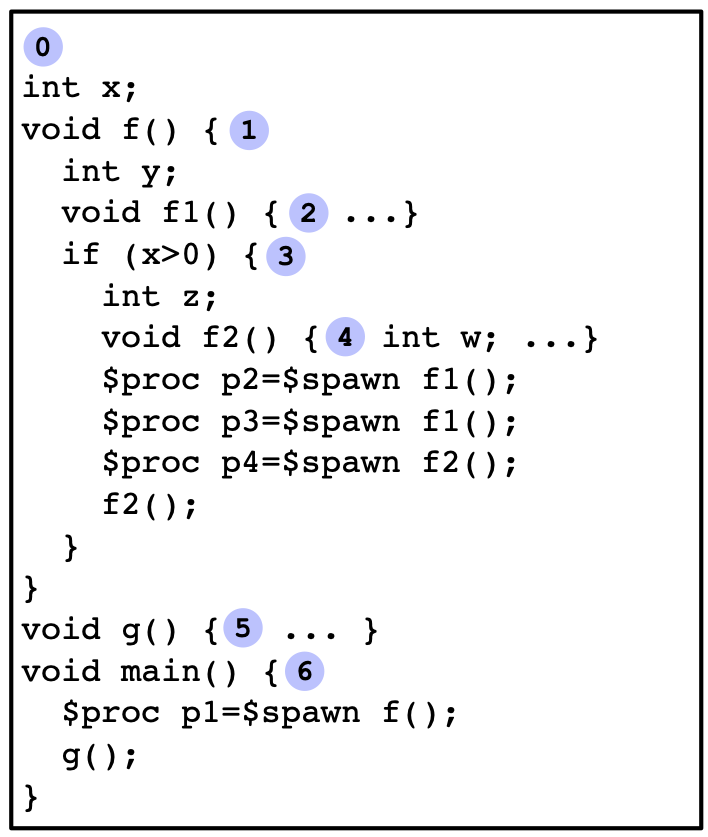
To understand the static and dynamic nature of scopes and processes, and the relations between them, we consider the (artificial) example code below. The static scopes in the scope are numbered from 0 to 6.

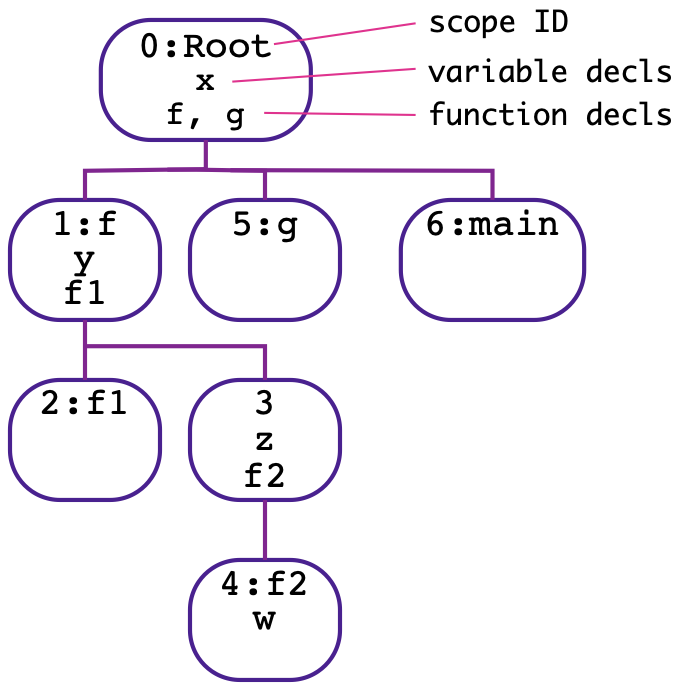
The static scopes have a tree structure: one scope is a child of another if the first is immediately contained in the second. Scope 0, which is the file scope (or root scope) is the root of this tree. The static scope tree is depicted in Figure 5.2 (left). Each scope is identified by its integer ID. Additionally, if the scope happens to be the scope of a function definition, the name of the function is included in this identifier. A node in this tree also shows the variables and functions declared in the scope. For brevity, we omit the proc variables.
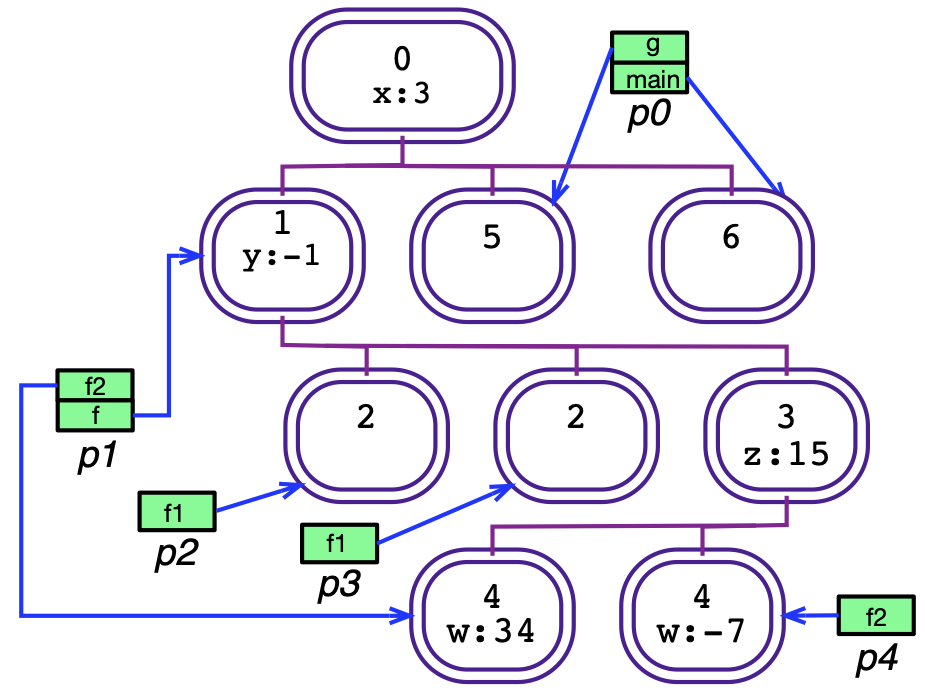
We now look at what happens when this program executes. Figure 5.2 (right) illustrates a
Attachments (3)
-
scopeCodeExample.png
(84.1 KB
) - added by 3 years ago.
CIVL-C code skeleton to illustrate scope hierarchy
-
staticScopeTree.png
(65.3 KB
) - added by 3 years ago.
Static scope tree
-
scopeStateExample.png
(101.2 KB
) - added by 3 years ago.
A state for example program
Download all attachments as: .zip