| Version 13 (modified by , 3 years ago) ( diff ) |
|---|
CIVL-C Language
Overview of CIVL-C
Main Concepts
CIVL-C is an extension of a subset of Standard C. It includes the most commonly-used elements of C, including most of the syntax, types, expressions, and statements. Missing are some of the more esoteric type qualifiers, bitwise operations (at least for now), and much of the standard library. Moreover, none of the C language elements dealing with concurrency are included, as CIVL-C has its own concurrency primitives.
The keywords in CIVL-C not already in C begin with the symbol $. This makes them readily identifiable and also prevents any naming conflicts with identifiers in C programs. This means that most legal C programs will also be legal CIVL-C programs.
One of the most important features of CIVL-C not found in standard C is the ability to define functions in any scope. (Standard C allows function definitions only in the file scope.) This feature is also found in GNU C, the GNU extension of C.
Another central CIVL-C feature is the ability to spawn functions, i.e., run the function in a new process (thread).
Scopes and processes are the two central themes of CIVL-C. Each has a static and a dynamic aspect. The static scopes correspond to the lexical scopes in the program—typically, regions de- limited by curly braces {. . . }. At runtime, these scopes are instantiated when control in a process reaches the beginning of the scope. Processes are created dynamically by spawning functions; hence the functions are the static representation of processes.
Example Illustrating Scopes and Processes
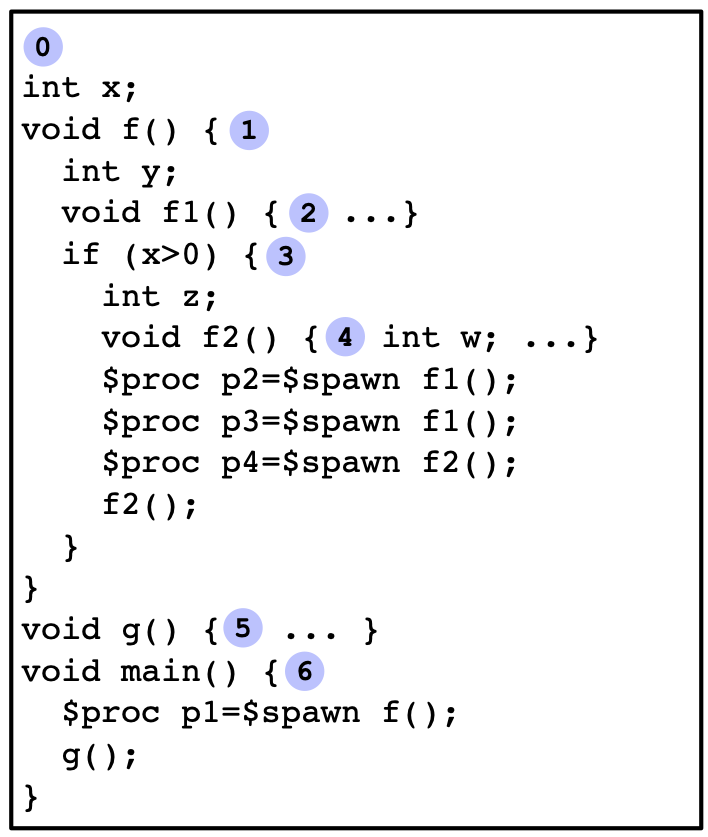
To understand the static and dynamic nature of scopes and processes, and the relations between them, we consider the (artificial) example code in Fig. 1(a). The static scopes in the code are numbered from 0 to 6.


|
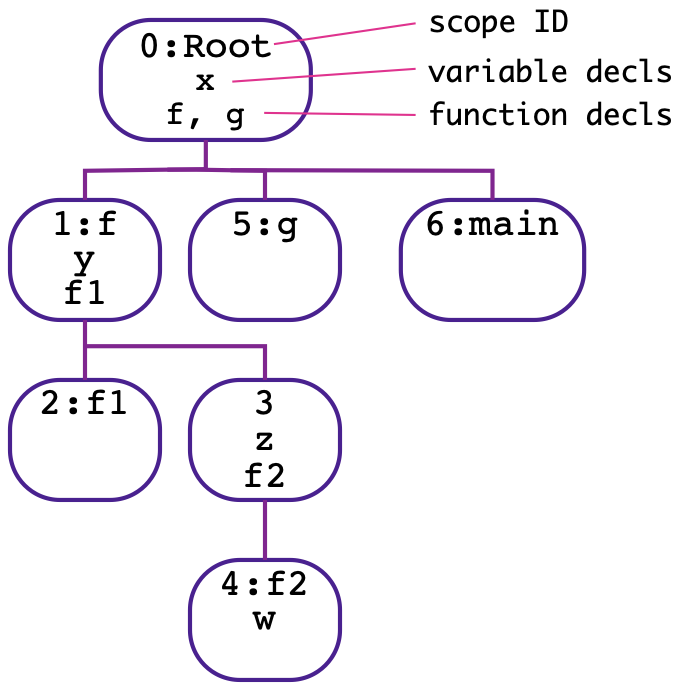
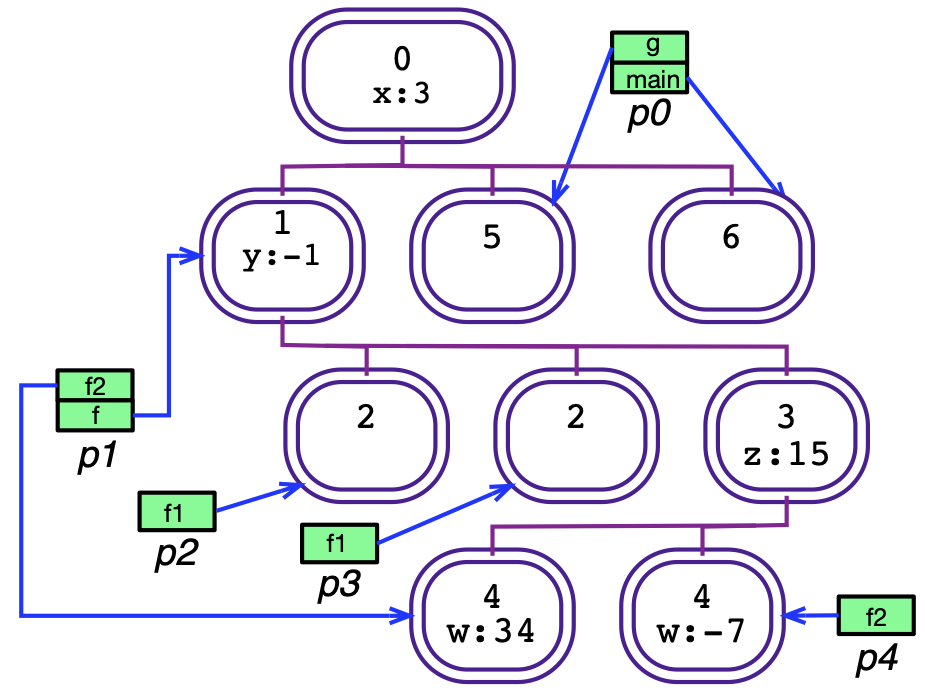
Fig. 1. CIVL-C scopes. (a) code skeleton to illustrate scope hierarchy. (b) static scope tree. (c) a state showing dynamic scopes and process call stacks
The static scopes have a tree structure: one scope is a child of another if the first is immediately contained in the second. Scope 0, which is the file scope (or root scope) is the root of this tree. The static scope tree is depicted in Fig. 1(b). Each scope is identified by its integer ID. Additionally, if the scope happens to be the scope of a function definition, the name of the function is included in this identifier. A node in this tree also shows the variables and functions declared in the scope. For brevity, we omit the proc variables.
We now look at what happens when this program executes. Fig. 1(c) illustrates a possible state of the program at one point in an execution. We now explain how this state is arrived at.
First, there is an implicit root function placed around the entire code. The body of the main function becomes the body of the root function, and the main function itself disappears. This minor transformation does not change the structure of the scope tree.
Execution begins by spawning a process p0 to execute the root function. This causes scope 0 to be instantiated. An instance of a static scope is known as a dynamic scope, or dyscopes for short. The dynamic scopes are represented by the ovals with double borders in Fig. 1(c). Each dyscope specifies a value for every variable declared in the corresponding static scope. In this case, the value 3 has been assigned to variable x.
The state of process p0 is represented by a call stack (green). The entries on this stack are activation frames. Each frame contains two data: a reference to a dyscope (indicated by blue arrows) and a current location (or programmer counter vaule) in the static scope corresponding to that dyscope (not shown). The dyscope defines the environment in which the process evaluates expressions and executes statements. The currently executing function of a process, corresponding to the top frame in the call stack, can “see” only the variables in its dyscope and those of all the ancestors of its dyscope in the dyscope tree.
Returning to the example, p0 enters scope 6, instantiating that scope, and then spawns procedure f. This creates process p1, with a new stack with a frame pointing to a dyscope corresponding to static scope 1. The new process proceeds to run concurrently with p0. Meanwhile, p0 calls procedure g, which pushes a new entry onto its call stack, and instantiates scope 5. Hence p0 has two entries on its stack: the bottom one pointing to the instance of scope 6, the top one pointing to the instance of scope 5.
Meanwhile, assume x > 0, so that p1 takes the true branch of the if statement, instantiating scope 3 under the instance of scope 1. It then spawns two copies of procedure f1, creating processes p2 and p3 and two instances of scope 2. Then p1 spawns f2, creating process p4 and an instance of scope 4. Note that the instance of scope 4 is a child of the instance of scope 3, since the (static) scope 4 is a child of scope 3. Finally, p1 calls f2, pushing a new entry on its stack and creating another instance of scope 4. The final state arrived at is the one shown.
There are few key points to understand:
- In any state, there is a mapping from the dyscope tree to the static scope tree which maps a dyscope to the static scope of which it is an instance. This mapping is a tree homomorphism, i.e., if dyscope u is a child of dyscope v, then the static scope corresponding to u is a child of the static scope corresponding to v.
- A static scope may have any number of instances, including 0.
- Dynamic scopes are created when control enters the corresponding static scope; they disappear from the state when they become unreachable. A dyscope v is “reachable” if some process has a frame pointing to a dyscope u and there is a path from u up to v that follows the parent edges in the dyscope tree.
- Processes are created when functions are spawned; they disappear from the state when their stack becomes empty (either because the process terminates normally or invokes the exit system function).
Structure of a CIVL-C program
A CIVL-C program is structured very much like a standard C program. In particular, a CIVL- C program may use the preprocessor directives specified in the C Standard, and with the same meaning. A source program is preprocessed, then parsed, resulting in a translation unit, just as with standard C. The main differences are the nesting of function definitions and the new primitives beginning with $, which are described in detail in the remainder of this part of the manual.
If the suffix of the filename of the program is not .cvl, then the program must include the line
#include <civlc.cvh>
somewhere near the beginning (before any CIVL-C primitives are used). This includes the main CIVL-C header file, which declares all the types and other CIVL primitives.
As usual, a translation unit consists of a sequence of variable declarations, function prototypes, and function definitions in file scope. In addition, assume statements may occur in the file scope. These are used to state assumptions on the input values to a program.
Sequential Elements
In this chapter we describe the main sequential elements of the language. For the most part these are the same as in C. Primitives dealing with concurrency are introduced in the next chapter.
Types
Standard types inherited from C
The civlc.cvh defines standard types inherited from C. The boolean type is denoted _Bool, as in C. Its values are 0 and 1, which are also denoted by $false and $true, respectively.
There is one integer type, corresponding to the mathematical integers. Currently, all of the C integer types int, long, unsigned int, short, etc., are mapped to the CIVL integer type.
There is one real type, corresponding to the mathematical real numbers. Currently, all of the C real types double, float, etc., are mapped to the CIVL real type.
Array types, struct and union types, char, and pointer types (including pointers to functions) are all exactly as in C.
The bundle type: $bundle
CIVL-C includes a type named $bundle, declared in the CIVL-C standard header bundle.cvh. A bundle is basically a sequence of data, wrapped into an atomic package. A bundle is created using a function that specifies a region of memory. One can create a bundle from an array of integers, and another bundle from an array of reals. Both bundles have the same type, $bundle. They can therefore be entered into an array of $bundle, for example. Hence bundles are useful for mixing objects of different (even statically unknown) types into a single data structure. Later, the contents of a bundle can be extracted with another function that specifies a region of memory into which to unpack the bundle; if that memory does not have the right type to receive the contents of the bundle, a runtime error is generated. The bundle type and its functions are provided by the library bundle.cvh.
The relevant functions for creating and manipulating bundles are given in ...
The $scope type
An object of type $scope is a reference to a dynamic scope. It may be thought of as a “dynamic
scope ID, ” but it is not an integer and cannot be converted to an integer. Operations defined on scopes are discussed in Section ....
The $range and $domain types
CIVL-C provides certain abstract datatypes that are useful for representing iteration spaces of loops in an abstract way.
First, there is a built-in type $range. An object of this type represents an ordered set of integers. There are expressions for specifying range values; these are described in Section .... Ranges are typically used as a step in constructing domains, described next.
A domain type is used to represent a set of tuples of integer values. Every tuple in a domain object has the same arity (i.e., number of components). The arity must be at least 1, and is called the dimension of the domain object.
For each integer constant expression n, there is a type $domain(n), representing domains of dimension n. The universal domain type, denoted $domain, represents domains of all positive dimensions, i.e., it is the union over all n ≥ 1 of $domain(n). In particular, each $domain(n) is a subtype of $domain.
There are expressions for specifying domain values; these are described in Section 6.2.3.2. There are also certains statements that use domains, such as the “CIVL-for” loop $for; see Section ...
Attachments (3)
-
scopeCodeExample.png
(84.1 KB
) - added by 3 years ago.
CIVL-C code skeleton to illustrate scope hierarchy
-
staticScopeTree.png
(65.3 KB
) - added by 3 years ago.
Static scope tree
-
scopeStateExample.png
(101.2 KB
) - added by 3 years ago.
A state for example program
Download all attachments as: .zip